
Your First Volume Order With a Fragrance Manufacturer, Stage by Stage
The first large fragrance order is not a bigger version of the trial run. It is a project with its own gates, its own documents and its own failure modes, and the sequence matters more than the speed. Knowing the eight stages in advance — and what each one is supposed to produce — is what turns a stressful first programme into a manageable one. The walkthrough below follows one order from the purchase order to the delivery note.
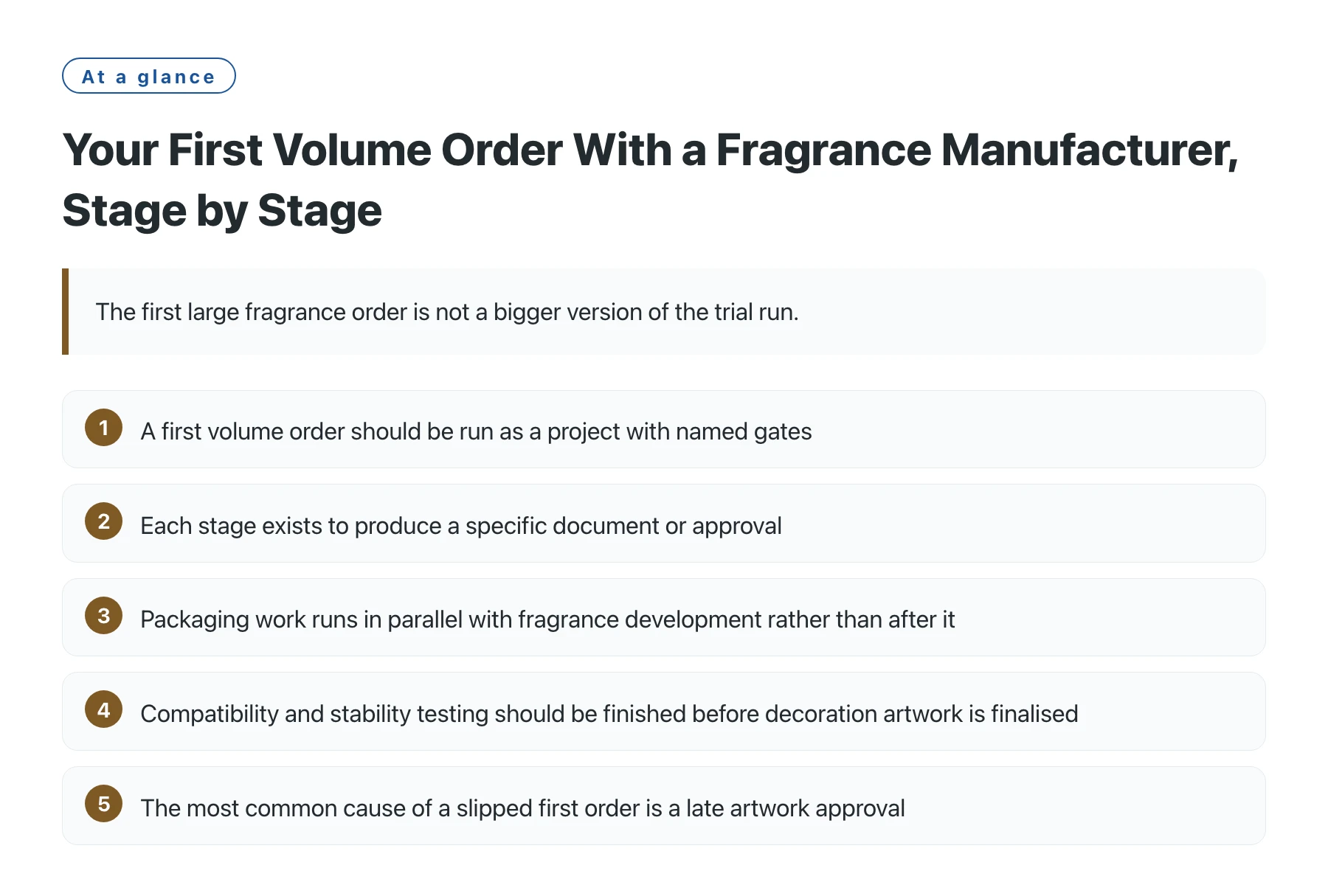
Key takeawaysA first volume order should be run as a project with named gates, not as a purchase that moves through a factory. · Each stage exists to produce a specific document or approval, and skipping one usually reappears as a delay two stages later. · Packaging work runs in parallel with fragrance development rather than after it, because container and decoration lead times are often the longest. · Compatibility and stability testing should be finished before decoration artwork is finalised, since a change to either can invalidate the other. · The most common cause of a slipped first order is a late artwork approval, not a slow production line. · Retaining a sealed reference sample and the batch record is what makes the second order easier than the first.
Buyers who have commissioned packaging, print or contract manufacturing elsewhere tend to arrive with good instincts. They ask about tooling, lead times and inspection. Fragrance adds two complications to that familiar pattern: the core product is judged by perception rather than measurement, and the ingredients are regulated in ways that vary by market and product category.
The result is a sequence that rewards patience in specific places and punishes impatience in others. What follows is that sequence as a manufacturer would run it, with the points where a brand's own decisions are on the critical path.
The eight stages of a first volume order
- Purchase order and specification freezeThe order confirms quantity, delivery window and the specification version both sides are working to. Everything downstream refers back to this version number.
- Component and material readiness checkGlass, closures, cartons and decoration consumables are checked against the order quantity, including realistic yield loss. This is where shortfalls are found while there is still time to react.
- Bulk production of the fragrance compoundThe compound is produced or compounded to the approved formula, then rested for the period agreed in development. Rushing this step is one of the classic reasons bulk smells different from the sample.
- Bulk filling and assemblyThe juice is filled to the specified weight and tolerance, the closure is crimped or fitted, and the batch is coded so it can be traced.
- Decoration and finishingPrinting, coating, frosting or foiling is applied, either before or after filling depending on the process. Colour and registration are checked against the approved standard.
- In-process and finished checksFill checks, leak tests, spray performance, appearance and packing checks are run against the specification. Deviations are recorded, not quietly corrected.
- Packing and documentationRetail or transit packing is completed and the document pack is assembled for the destination market.
- Shipment and reference retentionGoods ship, and a sealed reference sample plus the batch record stay with the manufacturer for future comparison.
What each stage is really protecting
Read the stages as defences rather than as a timetable. The materials readiness check protects the delivery date. The resting period protects the olfactive result. The in-process checks protect the batch, and the retained reference protects the second order.
Two of the eight stages involve testing with a formal output. Finished cosmetic products are commonly tested for stability, packaging compatibility and microbiological quality, and those reports are the evidence a brand relies on when a retailer or a market asks how the product was validated [1]. Without them, a first order is validated by opinion.
When the brand does not yet own a formula, the sequence starts one stage earlier, with development. That work is different in kind from production and is worth scoping separately, because a custom fragrance development partner normally needs a written brief, a target market and a unit cost ceiling before the first sample is produced.
The market decides part of the sequence
Where the product will be sold shapes which documents have to exist and when. Placing a cosmetic product on the European market, for example, brings a defined set of responsibilities onto the party that puts it there, and those responsibilities translate into documents a manufacturer may or may not provide [2]. Sorting out who provides what before the artwork is finalised avoids the awkward situation of a label design that has to change after printing.
Packaging is a parallel project
Brands frequently sequence packaging after scent approval, on the assumption that the hard part is the fragrance. In practice the container and decoration are often the longest items in the plan. Packaging also carries its own environmental obligations in some markets, and the direction of travel in European packaging policy affects what a brand may need to declare or design for [3].
Designing for recyclability is not a single decision but a set of them: material choice, decoration method, whether the pump can be separated, whether refills are offered. Industry guidance on packaging design exists precisely because these choices trade off against each other [4]. Raising them at the first-order stage is far cheaper than raising them after a mould has been cut.
Stage, gate and the sign-off each one needs
| Stage | Gate to pass | Who signs | What goes wrong if it is skipped |
|---|---|---|---|
| Order and freeze | Specification version confirmed by both sides | Brand and manufacturer | Work proceeds against two different documents |
| Materials readiness | Quantities reconciled with yield loss | Manufacturer | Shortfall discovered during assembly |
| Bulk compounding and resting | Rest period completed as agreed | Manufacturer technical | Bulk reads differently from the approved sample |
| Filling and assembly | Fill weight and leak checks within tolerance | Line quality control | Leaks, underfills and returns after shipping |
| Decoration | Colour and registration match the approved proof | Brand creative and manufacturer | A pallet of packaging that cannot be sold |
| Packing and documents | Document pack complete for the destination market | Brand compliance and manufacturer | Goods held at customs or refused by a retailer |
If the first order is planned with these gates visible, the second order becomes largely administrative. Most of the difficulty in a first programme is not the manufacturing itself but the number of decisions that were never formally closed.
Where first volume orders actually lose time
In reviews of delayed first orders, the same three causes appear. Late artwork approval is the most common, because it depends on a design process that runs to its own clock. The second is a specification change after tooling or printing plates exist. The third is a materials shortfall discovered late because yield loss was underestimated on a decorated component.
A fourth cause is structural rather than operational: the brand assumed a partner's published scope covered work that in fact sat outside it. Service pages are useful for orientation — a manufacturer such as Xuelei Fragrance sets out what its OEM/ODM manufacturing services include, and reading them carefully is a sensible first step — but the working scope is the document signed for your project.
One more habit is worth adopting before the order is placed: ask to see how comparable projects were structured. Looking at examples of fragrance projects before your own brief is written is a cheap way to learn which questions the factory will ask you, and it shortens the first meeting considerably.
Build the schedule backwards from the shelf date
Take the date the product must be on shelf, subtract retail distribution, freight, packing, decoration and process time, and you arrive at the date the purchase order must be placed. Doing this arithmetic before negotiation is more persuasive than asking for a lead time and hoping.
A first volume order goes best when one person inside the brand owns the schedule and one person inside the manufacturer owns the project, and both are named in the specification document. Programmes that lose weeks usually lose them in the space between two organisations, in a decision that everyone assumed someone else had made. Naming the two owners closes that space at almost no cost.
Sources
- SGS: Cosmetics, Personal Care & Household Testing —— Testing, inspection and certification services for cosmetics and personal care, including microbiological, stability and safety testing aligned with cosmetics GMP.
- European Commission: Cosmetics in the EU —— The European Commission's overview of EU cosmetics rules, including the responsible person, product information file and safety report requirements.
- European Commission: Packaging Waste and the PPWR —— EU rules on packaging and packaging waste, including the Packaging and Packaging Waste Regulation requirements on recyclability and design.
- Sustainable Packaging Coalition —— A membership organisation working on more sustainable packaging design, publishing material and recyclability guidance.
Frequently asked questions
How long does a first large fragrance order take from purchase order to delivery?
It depends on the container and decoration, which are usually the longest items, and on how quickly artwork is approved. A realistic plan is built backwards from the shelf date rather than taken from a general lead-time figure, because the fragrance itself is rarely the constraint.
Do I need stability and compatibility tests before my first volume order?
They should be completed before artwork is finalised and before bulk filling, because a compatibility failure can force a change to the container or the formula. Accredited cosmetics testing commonly covers stability, packaging compatibility and microbiological quality.
Why does bulk production smell different from my approved sample?
The usual causes are insufficient resting time after compounding, a different carrier ratio at scale, or materials from a different lot. The remedy is a sealed reference sample, a documented rest period, and a comparison of the first bulk batch against the reference before filling.
What is the most common reason a first order slips?
Late approval of artwork or decoration. The production line is rarely the bottleneck; the critical path usually runs through the brand's own design and sign-off process, which is why the schedule should be built around those decisions.
Should the brand keep its own reference sample?
Yes. Ask for at least one sealed unit from the bulk batch, stored under the conditions stated on the specification. A reference held by both sides makes any later conversation about consistency much shorter.
Ship your next model with a senior architect.
A 30-minute scoping call with our solutions team — no slideware, just an honest read of your stack.